Tag: education

  • Support of children affected by the humanitarian crisis in Ukraine: Bridging practice and learning through the sharing of experience

    Support of children affected by the humanitarian crisis in Ukraine: Bridging practice and learning through the sharing of experience

    Psychological First Aid in Support of Children Affected by the Humanitarian Crisis in Ukraine: the Experiences of Children, Caregivers and Helpers

    “Do you have an experience supporting children affected by the humanitarian crisis in Ukraine that you would like to share with colleagues? Tell us what happened and how it turned out. Be specific and detailed so that we can understand your story.”

    This was one of the questions that applicants to the Certificate peer learning programme on Psychological First Aid (PFA) in support of children affected by the humanitarian crisis in Ukraine could choose to answer.

    If you are reading this, you may be one of the education, health, or social work professionals who answered questions like these. You may also be a policy maker or organizational leader asking yourself how children from Ukraine and the people who work with them can be better supported.

    The Geneva Learning Foundation (TGLF), in collaboration with the International Federation of Red Cross and Red Crescent Societies (IFRC) and with support from the European Union’s EU4Health programme, is pleased to announce the publication of the first “Listening and Learning” report focused on the experiences of education, social work, and health professionals who support children affected by the humanitarian crisis in Ukraine.

    This new report, published in both Ukrainian and English editions, gives back the collected experiences of 873 volunteers and professionals who applied to this new programme in spring 2024.

    Readers will find short, thematic analyses. A comprehensive annex is also included to present the full compendium of experiences shared.

    To transform these rich experiences into actionable insights, the Foundation’s Insights Unit applied a rigorous analytical process. This included systematic consolidation of data, thematic analysis to identify recurring patterns, synthesis of key trends and effective practices, and careful curation of representative experiences. This methodology allows for the rapid sharing of on-the-ground knowledge and innovative practices tailored to the specific context of MHPSS in humanitarian crises. As with any qualitative analysis, these insights should be considered alongside other forms of evidence and expertise in the field.

    Experiences shared reflect the intrinsic motivation of helpers, their subtle attention to children, the magic of doing the right thing at the right moment. They also describe the personal and practical challenges helpers face when working with distressed individuals and communities, often with limited resources. 

    This programme, offered by The Geneva Learning Foundation (TGLF) in partnership with the International Federation of Red Cross and Red Crescent Societies (IFRC), employs an innovative peer learning-to-action model grounded in the most recent advances in the learning sciences.

    To complement existing top-down skills-based training in Psychological First Aid (PFA), we are working with IFRC to create structured opportunities for practitioners to learn directly from each other’s experiences while applying what they learn to their own work, aligning to the best guidance and norms for mental health and psychosocial support. For professionals working in crisis settings, this offers several key advantages:

    It leverages the collective expertise and tacit knowledge of practitioners on the ground.

    It creates a supportive community of action, connecting professionals across boundaries of geography, hierarchy, and job roles.

    It helps bridge gaps between theory and practice by positioning learning at the point of work.

    It fosters critical thinking and problem-solving skills through peer analysis and feedback.

    It is highly adaptable and can be implemented quickly in response to emerging crises.

    This process not only enhanced participants’ understanding of Psychological First Aid principles but also built their capacity to critically reflect on and improve their practice. By engaging professionals from across Europe and Ukraine in both English and Ukrainian cohorts, the exercise fostered cross-cultural exchange and mutual learning.

    As the humanitarian sector continues to grapple with how to effectively build capacity at scale, particularly in rapidly evolving crisis situations, we believe this peer learning-to-action model offers a promising pathway. It empowers practitioners as both learners and teachers, creating a dynamic and sustainable approach to professional development that can adapt to meet emerging needs.

    The Foundation would like to thank IFRC, the Psychosocial Support Centre (PSC), National Societies, as well as the network of governmental and non-governmental organizations across Europe that has engaged in this new approach, as a complement to their efforts on the ground. As the programme continues through to June 2025, this report will be followed by others to share what we learned from successive peer learning exercises, folllowed by the development and implementation of local projects guided by the collective intelligence of practitioners.

    We invite you to explore these insights, reflect on their implications for your own work, and consider how this approach might be applied to strengthen mental health and psychosocial support capacity in your own context.

    The Geneva Learning Foundation

    Image: The Geneva Learning Foundation Collection © 2024

  • From communication to education

    From communication to education

    There is of course an intimate relationship between communication and education. In many universities, both sit under the discipline of psychology.

    However, in most international organizations, these tend to be siloed functions. Communication often focuses on external media relations and, in the last few years, has expanded to take on the role of organizing social media presence. Education is reduced to ‘training’ or subsumed under staff (or talent) development, sometimes (but not always) inside of human resources. Worst-case scenario: an organization may not even have a centralized learning function, even though a quick survey would probably reveal that learning, education and training are at the core of its knowledge production and dissemination.

    Communication counts eyeballs, downloads, or retweets.

    Education tracks what is happening behind the eyeballs – and changes it, in measurable ways. This is equally true of the industrial-age classroom (and its organizational corollary, the training workshop) as it is of online learning environments that maximize technology’s amazing economy of effort.

    In a knowledge-driven economy, impact matters more than perception.

    In addition to being ephemeral (especially social media), this is why communication-based approaches feel increasingly superficial.

    Photo: Philadelphia sunrise, 21 April 2013.

  • Bill Gates on education, MOOCs, poverty and disease

    Bill Gates on education, MOOCs, poverty and disease

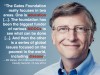
    This quote is not new. Given the increasing focus of MOOC debates on corporate MOOCs, it is interesting because bridging gaps in knowledge and skills is needed to address global health and poverty gaps. However, these twin strands of the Gates Foundation have, so far, been led by separate teams.

  • Maybe old learning isn’t so bad, after all?

    When I first saw Professor Cope’s photos of a 1983 elementary school classroom, I scoffed. It was so obvious that the “communications and knowledge architecture” was one-way, focused on rote learning and rewarding good behavior which involved staying safely “inside the box”. How easy to critique, deconstructing all of the ways in which this particular “banking” form of education was unlikely to intentionally “deposit” anything that might actually be useful to the future lives of these school children. How awful, I thought, and how at odds with everything I try to put into practice with respect to my own professional role. Today’s MOOCs and flipped classrooms, with their objectives of making active knowledge-making ubiquitous, make 1983 look like the Dark Ages of education.

    And yet. And yet this classroom very closely resembles the ones in which I grew up, with 5th grade in 1980 as a reference point. And I was one of the kids for whom it was an enjoyable experience. I thrived in that environment. I wanted to sponge up the facts and figures, and was proud to raise my hand, hoping the teacher would pick me. Group work simply wasn’t as much fun or rewarding as the individual recognition and praise from the teacher. It’s only when I jog my 42-year-old brain to recall what made me enjoy school so much that I realize it was the interaction, the creativity, and the serendipity. But the scaffolding was sturdy and reassuring precisely because it was so rigid and didactic.

    The same with university. In my professional life, I proclaim my belief that the time for “post-campus education” has arrived. Speaking to a group of young interns, I explained recently that they could expect that their life-long learning had only just begun, and that by abandoning the oh-so-twentieth-century sequence in which you complete your degree and then go to work, they could more actively shape their future careers.

    And yet. I was a first-generation college student, going to a university in the U.S. when both my parents never made it past elementary school. My father was put into an orphanage. My mother was denied the education she strived for when her school was closed by the French colonial forces when the Algerian Revolution started. The university campus was for me the site of life-changing experiences.

    Today I am also the father of three boys. Nassim, my six-year-old, learned reading, writing and arithmetic this year. When it comes to his education, my approach is far-removed from cutting-edge education. I make him read and re-read texts, do and redo addition and subtraction exercises, drilling it in and checking constantly to see if it’s sunk in yet. Rewards are limited or non-existent with me. Sometimes he resists, complaining about the repetition or that it’s “too hard”. But he also seems to genuinely enjoy completing the exercises. I do this because I’m concerned that his public school teacher is going to be too “slack”, because he goes to school in a poor neighborhood in Paris where many of the kids face tough life circumstances, have parents who do not know how to read and write, and are considered by many (including teachers) to be destined for vocational training leading straight to unemployment. Especially if they are of Arab or African descent.

    So, what to do with such blatant contradictions between my professed interest in “new learning” and my personal experience? I believe this contradiction can be productive, meaning that I try to mobilize it to understand why colleagues and other interlocutors express skepticism about innovation in learning, whether explicitly or implicitly. And, yes, I’m also trying to rethink how I work with my sons after school. The world is changing. If we want learning to be supportive, participatory, inspiring, motivating, flexible… it’s not (only) because that will make learning a more pleasurable experience. It is because this is how our children (or those of others, for those to whom parents have delegated mass public education) will get the chance to develop the knowledge and skills they will need to not only survive but thrive — in the online classrooms before they learn the hard way, IRL.