Tag: innovation

  • Artificial intelligence, accountability, and authenticity: knowledge production and power in global health crisis

    Artificial intelligence, accountability, and authenticity: knowledge production and power in global health crisis

    I know and appreciate Joseph, a Kenyan health leader from Murang’a County, for years of diligent leadership and contributions as a Scholar of The Geneva Learning Foundation (TGLF). Recently, he began submitting AI-generated responses to Teach to Reach Questions that were meant to elicit narratives grounded in his personal experience.

    Seemingly unrelated to this, OpenAI just announced plans for specialized AI agents—autonomous systems designed to perform complex cognitive tasks—with pricing ranging from $2,000 monthly for a “high-income knowledge worker” equivalent to $20,000 monthly for “PhD-level” research capabilities.

    This is happening at a time when traditional funding structures in global health, development, and humanitarian response face unprecedented volatility.

    These developments intersect around fundamental questions of knowledge economics, authenticity, and power in global health contexts.

    I want to explore three questions:

    • What happens when health professionals in resource-constrained settings experiment with AI technologies within accountability systems that often penalize innovation?
    • How might systems claiming to replicate human knowledge work transform the economics and ethics of knowledge production?
    • And how should we navigate the tensions between technological adoption and authentic knowledge creation?

    Artificial intelligence within punitive accountability structures of global health

    For years, Joseph had shared thoughtful, context-rich contributions based on his direct experiences. All of a sudden, he was submitting generic mush with all the trappings of bad generative AI content.

    Should we interpret this as disengagement from peer learning?

    Given his history of diligence and commitment, I could not dismiss his exploration of AI tools as diminished engagement. Instead, I understood it as an attempt to incorporate new capabilities into his professional repertoire. This was confirmed when I got to chat with him on a WhatsApp call.

    Our current Teach to Reach Questions system has not yet incorporated the use of AI. Our “old” system did not provide any way for Joseph to communicate what he was exploring.

    Hence, the quality limitations in AI-generated narratives highlight not ethical failings but a developmental process requiring support rather than judgment.

    But what does this look like when situated within global health accountability structures?

    Health workers frequently operate within highly punitive systems where performance evaluation directly impacts funding decisions. International donors maintain extensive surveillance of program implementation, creating environments where experimentation carries significant risk. When knowledge sharing becomes entangled with performance evaluation, the incentives for transparency about AI “co-working” (i.e., collaboration between human and AI in work) diminish dramatically.

    Seen through this lens, the question becomes not whether to prohibit AI-generated contributions but how to create environments where practitioners can explore technological capabilities without fear that disclosure will lead to automatic devaluation of their knowledge, regardless of its substantive quality. This heavily depends on the learning culture, which remains largely ignored or dismissed in global health.

    The transparency paradox: disclosure and devaluation of artificial intelligence in global health

    This case illustrates what might be called the “transparency paradox”—when disclosure or recognition of AI contribution triggers automatic devaluation regardless of substantive quality. Current attitudes create a problematic binary: acknowledge AI assistance and have contributions dismissed regardless of quality, or withhold disclosure and risk accusations of misrepresentation or worse.

    This paradox creates perverse incentives against transparency, particularly in contexts where knowledge production undergoes intensive evaluation linked to resource allocation. The global health sector’s evaluation systems often emphasize compliance over innovation, creating additional barriers to technological experimentation. When every submission potentially affects funding decisions, incentives for technological experimentation become entangled with accountability pressures.

    This dynamic particularly affects practitioners in Global South contexts, who face more intense scrutiny while having less institutional protection for experimentation. The punitive nature of global health accountability systems deserves particular emphasis. Health workers operate within hierarchical structures where performance is consistently monitored by both national governments and international donors. Surveillance extends from quantitative indicators to qualitative assessments of knowledge and practice.

    In environments where funding depends on demonstrating certain types of knowledge or outcomes, the incentive to leverage artificial intelligence in global health may conflict with values of authenticity and transparency. This surveillance culture creates uniquely challenging conditions for technological experimentation. When performance evaluation drives resource allocation decisions, health workers face considerable risk in acknowledging technological assistance—even as they face pressure to incorporate emerging technologies into their practice.

    The economics of knowledge in global health contexts

    OpenAI’s announced “agents” represent a substantial evolution beyond simple chatbots or language models. If they are able to deliver what they just announced, these specialized systems would autonomously perform complex tasks simulating the cognitive work of highly-skilled professionals. The most expensive tier, priced at $20,000 monthly, purportedly offers “PhD-level” research capabilities, working continuously without the limitations of human scheduling or attention.

    These claims, while unproven, suggest a potential future where knowledge work economics fundamentally change. For global health organizations operating in Geneva, where even a basic intern position for a recent master’s degree graduate cost more than 200 times that of a ChatGPT subscription, the economic proposition of systems working 24/7 for potentially comparable costs merits careful examination.

    However, the global health sector has historically operated with significant labor stratification, where personnel in Global North institutions command substantially higher compensation than those working in Global South contexts. Local health workers often provide critical knowledge at compensation rates far below those of international consultants or staff at Northern institutions. This creates a different economic equation than suggested by Geneva-based comparisons. Many organizations have long relied on substantially lower local labor costs, often justified through capacity-building narratives that mask underlying power asymmetries.

    Given this history, the risk that artificial intelligence in global health would replace local knowledge workers might initially appear questionable. Furthermore, the sector has demonstrated considerable resistance to technological adoption, particularly when it might disrupt established operational patterns. However, this analysis overlooks how economic pressures interact with technological change during periods of significant disruption.

    The recent decisions of many government to donors to suddenly and drastically cut funding and shut down programs illustrates how rapidly even established funding structures can collapse. In such environments, organizations face existential questions about maintaining operational capacity, potentially creating conditions where technological substitution becomes more attractive despite institutional resistance.

    A new AI divide

    ChatGPT and other generative AI tools were initially “geo-locked”, making them more difficult to access from outside Europe and North America.

    Now, the stratified pricing structure of OpenAI’s announced agents raises profound equity concerns. With the most sophisticated capabilities reserved for those able to pay high costs for the most capable agents, we face the potential emergence of an “AI divide” that threatens to reinforce existing knowledge power imbalances.

    This divide presents particular challenges for global health organizations working across diverse contexts. If advanced AI capabilities remain the exclusive province of Northern institutions while Southern partners operate with limited or no AI augmentation, how might this affect knowledge dynamics already characterized by significant inequities?

    The AI divide extends beyond simple access to include quality differentials in available systems. Even as simple AI tools become widely available, sophisticated capabilities that genuinely enhance knowledge work may remain concentrated within well-resourced institutions. This could lead to a scenario where practitioners in resource-constrained settings use rudimentary AI tools that produce low-quality outputs, further reinforcing perceptions of capability gaps between North and South.

    Confronting power dynamics in AI integration

    Traditional knowledge systems in global health position expertise in academic and institutional centers, with information flowing outward to practitioners who implement standardized solutions. This existing structure reflects and reinforces global power imbalances. 

    The integration of AI within these systems could either exacerbate these inequities—by further concentrating knowledge production capabilities within well-resourced institutions—or potentially disrupt them by enabling more distributed knowledge creation processes.

    Joseph’s journey demonstrates this tension. His adoption of AI tools might be viewed as an attempt to access capabilities otherwise reserved for those with greater institutional resources. The question becomes not whether to allow such adoption, but how to ensure it serves genuine knowledge democratization rather than simply producing more sophisticated simulations of participation.

    These emerging dynamics require us to fundamentally rethink how knowledge is valued, created, and shared within global health networks. The transparency paradox, economic pressures, and emerging AI divide suggest that technological integration will not occur within neutral space but rather within contexts already characterized by significant power asymmetries.

    Developing effective responses requires moving beyond simple prescriptions about AI adoption toward deeper analysis of how these technologies interact with existing power structures—and how they might be intentionally directed toward either reinforcing or transforming these structures.

    My framework for Artificial Intelligence as co-worker to support networked learning and local action is intended to contribute to such efforts.

    Illustration: The Geneva Learning Foundation Collection © 2025

    References

    Frehywot, S., Vovides, Y., 2024. Contextualizing algorithmic literacy framework for global health workforce education. AIH 0, 4903. https://doi.org/10.36922/aih.4903

    Hazarika, I., 2020. Artificial intelligence: opportunities and implications for the health workforce. International Health 12, 241–245. https://doi.org/10.1093/inthealth/ihaa007

    John, A., Newton-Lewis, T., Srinivasan, S., 2019. Means, Motives and Opportunity: determinants of community health worker performance. BMJ Glob Health 4, e001790. https://doi.org/10.1136/bmjgh-2019-001790

    Newton-Lewis, T., Munar, W., Chanturidze, T., 2021. Performance management in complex adaptive systems: a conceptual framework for health systems. BMJ Glob Health 6, e005582. https://doi.org/10.1136/bmjgh-2021-005582

    Newton-Lewis, T., Nanda, P., 2021. Problematic problem diagnostics: why digital health interventions for community health workers do not always achieve their desired impact. BMJ Glob Health 6, e005942. https://doi.org/10.1136/bmjgh-2021-005942

    Artificial Intelligence and the health workforce: Perspectives from medical associations on AI in health (OECD Artificial Intelligence Papers No. 28), 2024. , OECD Artificial Intelligence Papers. https://doi.org/10.1787/9a31d8af-en

    Sadki, R. (2025). A global health framework for Artificial Intelligence as co-worker to support networked learning and local action. Reda Sadki. https://doi.org/10.59350/gr56c-cdd51

  • Global Health Otherwise interviews Reda Sadki

    Global Health Otherwise interviews Reda Sadki

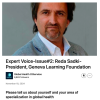
    Global Health Otherwise (GHO), an informal network spearheaded by Dr Luchuo Engelbert Bain, aims to “critically dissect the meanings of decolonization of global health practice, research, and funding”.  GHO spoke to The Geneva Learning Foundation’s Reda Sadki.

    Please tell us about yourself and your area of specialization in global health

    I am the founder and president of the Geneva Learning Foundation, a Swiss non-profit research-and-development organization and “think-and-do” tank. I have over two decades of experience in forging multi-disciplinary teams to invent and execute new ways to lead change through learning.

    My research and practice have explored the significance of learning and leadership to achieve impact, driven by my conviction that education is a powerful philosophy for change in the Digital Age.

    What does it take to make a great career in your area of expertise?

    Success requires understanding that most significant learning contributing to improved performance takes place outside formal training, through informal and incidental learning between peers.

    One must be willing to challenge conventional approaches and experiment with new models that leverage digital networks while maintaining human connections. It’s essential to stay curious, embrace complexity, and focus on enabling real-world impact rather than just knowledge transfer.

    What are the key challenges in your field, and how can these be overcome?

    Key challenges include:

    • Traditional top-down approaches that fail to reach scale or drive sustainable change
    • Disconnect between global expertise and local realities
    • Limited resources and access in low- and middle-income countries

    These can be overcome through:

    • Peer learning networks that connect practitioners across boundaries
    • Digital platforms that enable massive participation while maintaining quality
    • Focus on intrinsic motivation rather than external incentives
    • Emphasis on local action and contextual solutions

    In your view, what needs to change in your main area of interest, and how should we approach this?

    The field of global health learning needs to move beyond conventional training approaches to embrace more dynamic, networked models that empower local practitioners. We need to:

    • Recognize health workers as knowledge creators, not just recipients
    • Leverage digital tools to enable peer learning at scale
    • Focus on supporting locally-led change rather than imposing solutions
    • Build learning cultures that foster continuous improvement

    Can you share any real-world example success stories of your work?

    A notable success was the COVID-19 Peer Hub, which connected over 6,000 health professionals from 86 countries to share strategies for maintaining immunization services during the pandemic.

    Within three months, a third of participants had implemented recovery plans. The Movement for Immunization Agenda 2030 (IA2030) has grown to over 16,000 members across 100+ countries, demonstrating the power of peer learning to drive change.

    What advice would you give to policymakers and practitioners dealing with these issues?

    • Invest in digital infrastructure that enables peer learning
    • Trust and empower local health workers as agents of change
    • Design for scale from the start
    • Focus on creating conditions for learning rather than controlling outcomes
    • Embrace complexity and uncertainty rather than seeking simple solutions

    What do you think the future holds for the specific global health issue?

    The future of global health learning will increasingly rely on networked approaches that blend formal and informal learning.

    Digital platforms will continue to evolve, enabling more sophisticated forms of collaboration and knowledge sharing. Success will depend on our ability to support locally-led innovation while maintaining connections across geographic and institutional boundaries.

    Any final thoughts you’d like to share with the younger generation of practitioners aspiring to get into this area of work?

    For aspiring practitioners: Don’t be constrained by traditional models. The most powerful learning often happens through peer connections and real-world problem-solving.

    Focus on building networks and communities that can support continuous learning and adaptation. Remember that in today’s complex world, no one person or institution has all the answers – success comes from our ability to learn and evolve together.

  • Why become a Teach to Reach Partner?

    Why become a Teach to Reach Partner?

    We need new ways to tackle global health challenges that impact local communities.

    It is obvious that technology alone is not enough.

    We need human ingenuity, collaboration, and the ability to share across borders and boundaries.

    That is why I am excited about Teach to Reach.

    Imagine if we could tap into the collective intelligence of over 20,000 health professionals working on the front lines in low- and middle-income countries.

    What insights could we gain?

    What innovations might we uncover?

    This is exactly what Teach to Reach is doing.

    In June 2024, Teach to Reach 10 brought together 21,398 participants from across the health system – from community health workers to national policymakers.

    This diverse group represents an incredible wealth of knowledge and experience that has often been overlooked in global health decision-making.

    Bridge the gap between policy and practice

    One of the most exciting aspects of Teach to Reach is how it bridges the gap between policy and practice.

    Too often, there is a disconnect between those making decisions at the global level and those implementing programs on the ground.

    Teach to Reach creates a direct line of communication, allowing frontline workers to influence policy and program design in real-time.

    This approach not only leads to more effective interventions but also empowers health workers, increasing their engagement and motivation.

    Scale knowledge transfer and translation efficiently

    In global health, we are always looking for ways to scale solutions efficiently.

    This scaling effect is particularly crucial in low-resource settings, where formal learning opportunities may be limited.

    Teach to Reach applies this principle to peer learning.

    Then there is speed.

    The platform can disseminate best practices and local solutions much more rapidly than traditional top-down approaches.

    There is also the “know-do” gap or the “applicability problem”.

    Teach to Reach supports continuous learning by sharing experience, focused on how to get results, especially at the local community level.

    Measuring impact and driving innovation

    The Teach to Reach platform uses a comprehensive framework to track the value of participation for individuals and the benefits for partners.

    But we do not stop there.

    Teach to Reach is just one component in the Geneva Learning Foundation’s model to support new learning and leadership to drive change.

    We then track and measure what participants do with the knowledge gained and the experiences shared.

    We do this all the way to the time where improved health outcomes can be attributed to a discovery or significant learning made at Teach to Reach.

    Moreover, Teach to Reach serves as an innovation hub, surfacing diverse ideas and solutions from the field.

    For organizations looking to drive innovation in their global health programs, this platform offers a new path to creative problem-solving with those closest to the challenges.

    A call to action for global health leaders

    If you are a leader in the global health space, I urge you to consider partnering with Teach to Reach.

    Here are 5 ways in which partners have found utility in Teach to Reach:

    1. Inform a strategy with ground-level insights.
    2. Expand reach across multiple countries and health system levels.
    3. Tap into a diverse pool of local solutions – and help augment and scale them.
    4. Demonstrate commitment to supporting locally-led, community-based positive change.
    5. Accelerate progress towards global health goals through collaborative learning.

    In today’s interconnected world, our ability to solve global health challenges depends on our capacity to learn from one another and scale effective solutions quickly.

    Teach to Reach is pioneering a new approach that harnesses the power of peer learning to do just that.

    Investing in Teach to Reach can help unlock the full potential of our global health workforce and make significant strides towards a healthier, more equitable world.

    The future of global health is collaborative.

    Teach to Reach provides a way to turn the rhetoric of collaboration into practical action.

  • Hot fudge sundae

    Hot fudge sundae

    Through their research on informal and incidental learning in the workplace, Karen Watkins and Victoria Marsick have produced one of the strongest evidence-based framework on how to strengthen learning culture to drive performance.

    Here, Karen Watkins shares an anecdote from a study of learning culture in which two teams from the same company both engaged in efforts to reward creative and innovative ideas and projects. However, one team generated far more ideas than the other. You won’t believe what turned out to be the cause of the drastically disparate outcomes.


    I recorded Karen via Skype while she was helping me to perform my first learning practice audit, a mixed methods diagnostic that can provide an organization with new, practical ways to recognize, foster, and augment the learning that matters the most.

    Recognizing that the majority of learning, problem-solving, idea generation, and innovation do not happen in the training room – physical or digital–, is a key step in our approach to help organizations execute change.

    Karen is a founding Trustee of the Geneva Learning Foundation.

  • Skunk Works: 14 rules to live and die by

    Skunk Works: 14 rules to live and die by

    Lockheed’s Skunk Works may be one of the earliest models for sustaining innovation inside an organization – never mind the nefarious mission of making flying machines to kill people. These are the basic operations rules enunciated by founder Kelly Johnson in 1954, as cited in his successor Ben Rich’s book:

    1. The Skunk Works program manager must be delegated practically complete control of his program in all aspects. He should have the authority to make quick decisions regarding technical, financial, or operational matters.
    2. Strong but small project offices must be provided both by the military and the industry.
    3. The number of people having any connection with the project must be restricted in an almost vicious manner. Use a small number of good people.
    4. Very simple drawing and drawing release system with great flexibility for making changes must be provided in order to make schedule recovery in the face of failures.
    5. There must be a minimum number of reports required, but important work must be recorded thoroughly.
    6. There must be a monthly cost review covering not only what has been spent and committed but also projected costs to the conclusion of the program. Don’t have the books ninety days late and don’t surprise the customer with sudden overruns.
    7. The contractor must be delegated and must assume more than normal responsibility to get good vendor bids for subcontract on the project. Commercial bid procedures are often better than military ones
    8. The inspection system as currently used by the Skunk Works, which has been approved by both the Air Force and the Navy, meets the intent of existing military requirements and should be used on new projects. Push basic inspection responsibility back to the subcontractors and vendors. Don’t duplicate so much inspection.
    9. The contractor must be delegated the authority to test his final product in flight. He can and must test it in the initial stages.
    10. The specifications applying to the hardware must be agreed to in advance of contracting.
    11. Funding a program must be timely so that the contractor doesn’t have to keep running to the bank to support government projects.
    12. There must be absolute trust between the military project organization and the contractor with very close cooperation and liaison on a day-to-day basis. This cuts down misunderstanding and correspondence to an absolute minimum.
    13. Access by outsiders to the project and its personnel must be strictly controlled.
    14. Because only a few people will be used in engineering and most other areas, ways must be provided to reward good performance by pay not based on the number of personnel supervised.

    Source: Ben R. Rich and Leo Janos. Skunk Works: A Personal Memoir of My Years at Lockheed (1994). Kelly’s 14 Rules & Practices may also be found here.

    Photo: Skunk Works logo on Museum’s SR-71. Photo #2005-6014 by Dane Penland, Smithsonian National Air and Space Museum.

  • What does it mean to broker knowledge in a network?

    What does it mean to broker knowledge in a network?

    Our network function requires that we interact with the network. We observe profound changes in the nature of knowledge, how it circulates, and this affects how we work (learn).

    Members in the network, too, have changed. We struggle to keep up with and adapt to these changes. In working with them, we prioritize results against their own expectations as well as those of donors and governments.

    Hence, it is difficult to justify learning approaches that take us away from such priorities. We wish for time after delivery to reflect on lessons learned, but such wishes may be swept away by the next urgent task.

    The alternative to this frustrating cycle of task delivery at the expense of reflection is to adopt a knowledge brokering approach. We broker knowledge when we link learning with innovation in the context of the long history of work done by the network.

    When trying to solve a difficult problem, especially in emergencies, our “fear of failure” drives speed and urgency in finding innovative solutions. We trade off certainty for speed. By contrast, in most of our work, “fear of failure” inhibits speed and risk-taking, as we seek to execute what has been previously established as normative. Therefore, innovation processes require different indicators and metrics than those of execution.

    Knowledge brokering provides a model for how we might be able to embed innovation and learning into work, by recombining our past and current knowledge, leveraging the old to do new things in new ways.

    The historical model is for the center (headquarters) to produce “trickle-down” knowledge to be consumed by the periphery (network), with feedback as an occasional and exceptional event. For example, even though we know the importance of currency, we wait years before we consider updating guidelines, because making knowledge current requires stopping other work and concerted effort that is difficult to organize and resource.

    This traditional model in which members of the network request assistance from headquarters becomes increasingly difficult to sustain when there is more knowledge and everything is faster, calling into question traditional models of expertise.

    When we look for commonalities between network members, we question our assumptions about how different they are. In our new role as knowledge brokers, by working with many in the network, we facilitate access to the ideas, artifacts, and people that reside within one member or domain yet may be valuable in others. From this existing knowledge (which also considers existing trainings, guidelines, and tools), we strive to discover new combinations and new ways to transfer experience. When nodes in the network are thus empowered to “do for themselves”, the nature of our expertise changes and we change too.

    If members do for themselves, what then is the role for those of us who work in headquarters?

    Reference: Hargadon, A.B., 2002. Brokering knowledge: Linking learning and innovation. Research in Organizational behavior 24, 41–85.

    Photo: Wire (Kendra/flickr.com)

  • Emergencies kill learning habits

    Emergencies kill learning habits

    We recognize that large-scale, complex emergencies have a dramatic impact on many aspects of our work, including what and how we learn.

    Some may feel, based on experience, that emergencies kill learning habits. We put everything on hold – including the things we do to stay current – to focus on the emergency response.

    However, the disruptive power of emergencies and their intensity fosters new, informal learning and provokes incidental learning indispensable to solve new problems in new ways. That is real-time innovation.

    Therefore, because emergencies and the change they bring are a constant in our work, we need to harness their disruption and intensity to ensure that lessons are learned and applied – before, during, and after. This requires new approaches, tools, and a change in mindset. We need to retain not only what we learned, but also how we learned it.

    Photo: Rusting away along the river Congo (Julien Harneis/flickr.com)

  • Making humanitarians

    Making humanitarians

    The industry to tackle growing humanitarian and development challenges has expanded rapidly since the mid 1990s, but not nearly as fast as the scope and scale of the problems have spiraled. Professionalization was therefore correctly identified as a major challenge of its own, with over a decade of research led by Catherine Russ and others clearing the rubble to allow the sector to make sense of what needs to be done. The bottom line diagnosis is a now-familiar litany: a shortage of people and skills, lack of quality standards, inability to scale.

    Despite the growth of traditional university programs to credential specialized knowledge of these challenges and how to tackle them, young people armed with multiple masters find that they really start learning upon entering their first NGO. They face a dearth of entry-level positions (sometimes spending years as “interns” or other forms of under-recognized labor) and discover professional networks closed to them because legitimacy is based on shared experience, not formal qualifications.

    Certified professional development run by universities fail because these institutions are ill-equipped to deliver sub-degree qualifications, and rely on methods that seldom provide experience. This problem is not specific to humanitarians, but may be more acute because of the nature of the work and the knowledge involved.

    Meanwhile, specialized organizations that provide training, like REDR in the UK or Bioforce in France, have become increasingly good at developing competency-based certification for behavior that matches real-world needs. Their business model works best at small scale and high cost. They have also succeeded in establishing that the credential of value is one that is defined by and agreed upon by practitioners. However, their efforts remain mired in a legacy of transmissive training and a tradition of “workshop culture” that are difficult to overcome. Also, by the time a competency framework is described, new contexts and needs that dictate new behaviors have predictably emerged but cannot be captured by the rigidity of framework.

    A few organizations are trying to organize the online delivery of click-through information modules. Unfortunately, this approach has yet – to put it politely – to show measurable positive performance outcomes. And, admittedly, it is going to be tough to prove that three hours of clicking through bullet points followed by an information recall quiz corresponds to what 21st century humanitarians need to deliver. (Having said that, it is probably no worse than sitting in a workshop with a ‘trainer’ doing the clicking, whether in terms of learning efficacy or sheer pleasure).

    Save The Children’s Humanitarian Leadership Academy stands out in a number of ways in the current landscape. Their analysis is grounded in the rock-solid research by Russ and others, and they have assembled a ferociously professional team that combines all of the right job functions, encompassing both folks from the sector and those who are new to it. The project is rightly ambitious, given the scope and scale of the challenges faced, and they have succeeded in securing a large chunk of their funding needs from the UK government. They aim to serve not just Save’s training needs, but to become the connector for a broad set of organizations working together, trying to convert decades of preaching about capacity building in developing countries into practice. Last but not least, they are trying to think strategically about their use of digital technology for learning.

    Has the time come, as a defrocked high priest of corporate learning recently suggested, for a “Pan Humanitarian College of Conscience”? Could it be as simple as bringing everyone together to share content, resources, and determine quality and credentialing standards together? I don’t think so, mostly because the existing content, resources, and approaches are not getting the job done. We need to do new things in new ways, not an educational “We are the world”.

    Truly disruptive humanitarian education leverages the affordances of educational technology to offer continual learning experiences that foster sense-making and network formation linking young and old humanitarians in global practices, strengthening existing professional networks because collaboration and team work are how you complete the mission. Such experiences could focus on precisely what is unsaid and untaught in formal curricula, and considered unattainable by training. Even formal courses that are about acquiring foundational knowledge can have learners co-constructing knowledge together. These peers then find themselves part of a knowledge community where, as alumni, they are now in a position to provide support – and benefit from the new learnings of others in a virtuous cycle. This paradigm shift occurs when how we learn is aligned to how we work: collaboration, team work and leadership are premised on peer-to-peer relationships, across the diversity of contexts and people that humanitarians find themselves in.

    Such an approach fosters critical thinking and practice around specific areas of work but – and perhaps more importantly – around cross-cuting ways of thinking and doing. Yes, you could build courses that tap into knowledge communities around climate change, logistics, or market-based approaches. Focus on an area of work, zero in on its wicked problems, and drive learning efforts where they are most needed, producing knowledge that is directly applicable to work. Going further, new ways of learning foster new forms of leadership and innovation in the face of a volatile, uncertain, complex and ambiguous (VUCA) world, through courses that teach and deepen realist evaluation or tap into experiences from outside the sector – linking resilience and sustainability – to help new ways of thinking and doing emerge.

    Last but not least, this new humanitarian learning needs to include not just future professionals but also volunteers. As the Red Cross Red Cross Movement has taught us , volunteers are far more than part-time humanitarians. They are embedded in their communities and learn to use the cultural and tacit knowledge from belonging to empower themselves, their families, neighbors, and every member of the community – whatever their status, in a fully inclusive way. Making sense of what happens in your community in this century, more so than ever before, requires that you establish a fluid two-way connection to global knowledge.

    While these are admittedly lofty objectives, the science of learning combined with educational technology are poised to make this more than just wishful thinking. Scaling up is currently center stage in both education (thank you, MOOCs) and humanitarian realms. There have been a small but significant number of well-researched, successful, small-scale pilots to foster new forms of humanitarian learning. The learners who participated in such experiments got it – even if some managers and decision makers did not. The missing link remains the network of learning leaders willing and able to think and fund the foundations for such an endeavor, and then to start building its scaffolding. And, who knows, such a group might find that Pan Humanitarian College of Conscience is a good fit to name what we might make together.

    Photo: Young man at a vocational education and training center, Marrakesh, Morocco. © Dana Smillie / World Bank

  • Complexity and scale in learning: a quantum leap to sustainability

    This is my presentation on 19 June 2014 at the Scaling corporate learning online symposium organized by George Siemens and hosted by Corp U.

  • A question of such immense and worldwide importance

    A question of such immense and worldwide importance

    Scale: Predictions over the impact of climate change and globalization suggest that we will see more frequent disasters in a greater number of countries, along with more civil unrest in those states less able to cope with this rapidly changing environment, all generating a greater demand for humanitarian and development assistance (cf. Walker, P., Russ, C., 2012. Fit for purpose: the role of modern professionalism in evolving the humanitarian endeavour. International Review of the Red Cross 93, 1193–1210.)

    Complexity: The world’s problems are characterized by volatility, uncertainty, and complexity in a knowledge society. The industry to tackle these growing challenges has expanded rapidly to become increasingly professionalized, with a concentrated number of global players increasingly focused on the professionalization of more than 600,000 paid aid workers and over 17 million volunteers active worldwide in UN agencies, the Red Cross and Red Crescent Movement, and the main international non governmental organizations (INGOs).

    Innovation: The scale and complexity of humanitarian and development issues call for doing new things in new ways. The skills and processes that will prepare the humanitarian workers of tomorrow are not yet embedded in our educational structures. In fact, education is failing to prepare humanity for the challenges of the future. Existing partnerships do not address this gap. Attempting to do more of what has been done in the past is not the answer. No single organization can solve a question of such immense and worldwide importance. It is the future of humanity that is at stake.

    Photo credit: NASA/Bill Ingalls via flickr.com