Category: Learning

  • Disseminating rapid learning about COVID-19 vaccine introduction

    Disseminating rapid learning about COVID-19 vaccine introduction

    In July 2019, barely six months before the pandemic, we worked with alumni of The Geneva Learning Foundation’s immunization programme to build the Impact Accelerator in 86 countries. This global community of action for national and sub-national immunization staff pledged, following completion of one of the Foundation’s courses, to support each other in other to achieve impact.

    Closing the loop from learning to impact produced startling results, accelerating the rate at which locally-resourced projects were implemented and fostering new forms of collaborative leadership. Alumni launched what immediately became the largest network of immunization managers in the world.

    Then the pandemic dramatically raised the stakes: at least 80 million children under one were placed at risk of vaccine-preventable diseases such as diphtheria, measles and polio as COVID-19 disrupted immunization service as worldwide.

    Alumni were amongst the first in their countries to respond, leveraging the power of being connected to each other to create a virtuous circle of peer support that became the COVID-19 Peer Hub. As a result, the pace of growth keeps increasing. Membership doubled during the summer of 2020.

    The network effect cannot be replicated by smaller platforms built on top-down legacy models of the past. Nor can the trust and friendship that bind members to each other.

    Members are telling their own stories of the COVID-19 pandemic, disseminating rapid learning, first about recovery of immunization services and, more recently, about COVID-19 vaccine introduction.

    There is no upper limit to the number of participants or stories. Rather than painstakingly collecting a few stories so highly curated that they seem too sanitized to be authentic or meaningful, we created the conditions for each person to share their story and learn from the stories of others. We do not require you to be “exemplary” to experience or share significant learning. Some of the most powerful lessons learned, in fact, come from the experience of failure.

    In November 2020, for example, members worked together to produce in just four weeks over 700 detailed, peer-reviewed case studies of vaccine hesitancy in health facilities and districts. These were used to inform the COVID-19 Peer Hub’s early scenario planning for vaccine introduction and are now being analyzed for the unique insights they contain, available by no other means.

    These stories are about collaboration and learning from each other, within and across borders and all levels of the health system, in new ways to do new things required to face the pandemic. I do not believe it is an overstatement to say that participants are writing history.

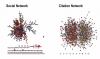
    Visualization of the sharing ideas and practices across borders, roles, and system levels in the COVID-19 Peer Hub

    Co-design as a networked practice of continuous invention, innovation, and learning

    For COVID-19 vaccine introduction to succeed, we need new ways to disseminate rapid learning. Through co-design with members of our platform, we invented two in the first three months of this year: Teach to Reach: Connect and the COVID-19 Peer Hub Inter-Country Learning Collaborative to support vaccine introduction.

    We already knew that presentation webinars do little more than replicate classroom training in a digital format. Yet they proliferate, despite the dearth of evidence about their effectiveness, with unsubstantiated claims that they are somehow “collaborative” or that 10 minutes of attendees asking the experts a few questions qualifies as “peer learning”. Social Network Analysis (SNA) of the COVID-19 Peer Hub by Sasha Poquet and Vitomir Kovanovic at the Centre for Complexity and Change in Learning helped us to understand that the power of the network lies in the relationships between its members, not only in our ability to convene or call to action, and certainly not in one-way information transmission.

    So, on Friday 26 March 2021, 1,372 immunization professionals attended Teach to Reach: Connect to meet, network, and learn about COVID-19 vaccine introduction, how to improve immunization training, and how to reach “zero-dose” children. The feedback received from participants has been incredible, starting with their own surprise that they had so much to learn from each other. (You can catch the opening ceremony on our YouTube channel, and we will soon be sharing what we learned in upcoming live-streamed events on our Facebook page.)

    My first networking meeting during Teach to Reach: Connect. Wasnam Faye is a district midwife in Senegal. I remembered her sharing powerful testimonial about how she took practical steps to ensure safe vaccination and explained the words she used to reassure caregivers, when the pandemic first hit.

    An inter-country peer learning collaborative to accelerate COVID-19 vaccine introduction

    The next day, the COVID-19 Peer Hub team from the Democratic Republic of the Congo (DRC) invited their colleagues from Ivory Coast to learn from the latter’s experience of vaccine introduction. Participants compared the enthusiasm to that for a football match, only this time, they said, the purpose was to “kick out the Coronavirus”. The meeting, hosted by DRC Peer Hub team leader Franck Monga and facilitated by a brilliant young doctor from Burkina Faso, Palenfo Dramane, drew over 1,000 attendees from 20 francophone countries. Panelists from Ivory Coast were alumni of Foundation programmes directly involved in vaccine introduction, working at various levels of the system. They shared first-hand experience from the first few weeks of vaccine introduction. Attendance barely declined even though the meeting ran over time by more than 90 minutes.

    Our ‘grand challenge’

    Our biggest challenge, so far, has been to explain the power, significance, potential, and value of such events to our global partners. This is ironic given that the global immunization community agrees that it is sub-national immunization staff who make the difference needed to achieve Immunization Agenda 2030, the new strategy adopted last year by the World Health Assembly. Some global colleagues did take the time to apologize, explaining that they were too busy on Friday afternoon due to COVID-19 vaccine introduction to take 15 minutes to meet, network, and learn with immunization staff from the countries they serve and who are actually introducing the vaccine. (To be fair, a few colleagues did attend and loved it.) Last but not least, donors remain risk-adverse, preaching innovation while repeatedly choosing conventional approaches and traditional partners, even when they have failed in the past, seemingly driven by considerations other than scale, results, or demand from countries. In some cases, they have even expressed disbelief, doubting our results as too good to be true, flummoxed by how a new entrant with limited immunization experience could achieve them when better-funded, far-more-legitimate institutions have simply not been able to do so.

  • Solidarity across public health and medicine silos during a pandemic

    Solidarity across public health and medicine silos during a pandemic

    We are launching a new Scholar programme about environmental threats to health, with an initial focus on radiation. (I mapped out what this might look like in 2017.) As part of the launch, we are enlisting support of immunization colleagues.

    Our immunization programme is our largest and most advanced programme, and still growing fast since its inception in 2016. At The Geneva Learning Foundation, we have spent 5 years pouring mind, body, and soul into building what has become the largest digital platform for national and sub-national immunization leaders.

    Along the way, we discovered that it is not only about scale. Social Network Analysis (SNA) by colleagues Sasha Poquet and Vitomir Kovanovic at the Centre for Complexity and Change in Learning is now helping us to understand the power in the relationships not just one-to-many but many-to-many across the network.

    Yes, there is a linkage as most vaccines are for children, and our first course in the new programme (with WHO) is about communicating radiation risks in paediatric imaging. But I was not sure if our request for help would make sense to the immunization network, especially when so many immunization staff are overwhelmed by COVID-19 vaccine introduction.

    Yet, in less than 2 hours, immunization colleagues had already shared the announcement over 300 times. This is an impressive display of solidarity across public health and medicine silos.

    This bodes well for the Foundation’s work as we are developing new programmes in other areas of global health, such as non-communicable diseases (NCDs) or neglected tropical diseases (NTDs) like female genital schistomiosis (FGS).

    Until this morning, I was not sure to what extent one programme’s members would be willing to support others, outside their field of specialty.

  • The significance of digital platforms to the business

    The significance of digital platforms to the business

    Business gets done by groups in workshops and meetings and by individuals in private conversation. There is an undeniable cultural advantage for diplomacy that comes from looking your interlocutor in the eye.

    Emerging digital platforms are in the margins of this business.

    The pioneers are creaky in their infrastructure and, ironically, playing catch-up. They have long lost the initial burst of enthusiasm that led to their creation. Yet they are still here, alive and kicking with funding that can support, in principle, their reinvention. For this, they need courage and creativity, especially if they function in a bureaucratic environment.

    Then there are new platforms in search of purpose and the users it would bring. Sometimes, it is the other way around.

    No platform is perfect. All of them have strengths, experience, insights, and the potential to be more in the future than what they are now. Some have already achieved individual impact and continue to do so.

    There is no doubt in my mind that, sooner than we think, our platforms – or the ones that will replace them – will be core to achieving the strategy being defined now for the coming decade.

    Digital transformation has swallowed enough industries that we now understand how it works.

    If you think about the newspaper industry, their web sites started in the margins too.

    Digital technologies provide a new economy of effort. In our context, we now have the means to address professionals working in the very communities where targets are either achieved or not. In fact, two-thirds of the Geneva Learning Foundation’s cohorts do not work in the capital city but in the regions and districts.

    Bypassing established gatekeepers and pyramidal hierarchies to go “straight to the customer” undeniably brings new challenges.

    What is the incentive for collaboration between digital platforms? We are all competing for the same resources, jostling for recognition, striving to demonstrate that we are contributing to the business.

    There are practical, operational reasons to share content, ideas, lessons learned. This can help each platform improve, for the benefit of the network that we all want to serve. Such service improvement is necessary and important.

    We can imagine a collective effort in which platforms rally around a shared goal and establish a shared measurement system to track progress.

    Yet, this too would be short-sighted.

    Yes, through a process of accretion, digital platforms will move from margin to center. They will not only be relevant to the business, they will be the business.

    The opportunity is for us to harness this process and accelerate the transformation so that it serves the strategic goals that are being defined today.

    To seize this opportunity, we need to start with the reality check:

    • Access is no longer the problem. (There is still a border beyond which there are no cell phone towers, but this border keeps receding.)
    • Digital literacy is the problem.

    Many learners in these platforms are discovering key online resources, available for years on the open web. A small but significant proportion may be part of the next billion of Internet users, joining to learn, not to surf.

    For this, we need a “no wrong door policy”. Wherever people enter the system, they need to find the pipes or pathways that will connect them to the destination that will help them solve the problem they are tackling. This is not about finding content, but the process of discovery that comes from connecting with others.

    The quality of the pipes will determine how quickly platforms become core business, rather than a nice-to-have.

    Image: Diving platform on Graveyard Hill in Kabul from TV-Hill, Afghanistan. Photo by Sven Dirks, Wien.

  • How do we measure the impact of informal and incidental learning on organizational performance?

    How do we measure the impact of informal and incidental learning on organizational performance?

    Evidence from learning science clearly identifies how to strengthen learning culture in ways that will drive performance. However, in a recent study conducted by Learning Strategies International (LSi), we quickly found limitations and gaps in the data available from the organization examined, despite the best effort by the organization’s staff to answer our questions and requests.

    We found two gaps that needed to be addressed before the most effective approaches to develop capabilities could  be applied usefully – and their impact measured:

    1. The gap between a commitment in principle to learning and skepticism about its actual value. (This gap surprised us.)
    2. Gaps in data and reporting needed to measure internal learning (and how to improve it).

    We believe that the first gap (skepticism about the value of learning) is the direct result of the second (lack of measurement).

    Without a measure of its impact on performance, internal (staff) learning is likely to be seen as a “nice-to-have” rather than a strategic priority.

    Measurement is needed to demonstrate the correlation between internal learning and performance.

    Measurement in learning is notoriously difficult. We recognise that although internal learning is critically important, many other variables determine organizational performance.

    It would be wonderful if it were possible to draw a straight line from internal learning to specific business outcomes, but it is not.

    Recognizing the value of informal learning further complicates measurement: self-directed learning, coaching, mentoring, and other informal learning strategies have this embedded capacity to allow us to learn much more than we intended or expected at the outset.

    This makes such learning more difficult to measure, but far more valuable to the participant, team, and organization. This is why we recommended:

    • the use of knowledge, mission, and financial performance of an organization or network as key metrics to correlate with learning culture; and
    • an evidence-based approach (already deployed in over 8,000 organisations and adapted by LSi for global, complex humanitarian networks) to measure these three performance variables and correlate them to the dimensions of learning culture.

    Featured image: Submarine control panel. Bowfin Submarine Museum, Pearl Harbor. Personal collection.

  • The future of learning that could have been

    The future of learning that could have been

    In June 2017, the Institute’s president, together with its Chief Learning Officer (CLO), convened an all-hands-on-deck meeting to announce the Institute’s commitment to strengthening its learning culture of innovation and change through an innovative, evidence-based internal learning strategy. Staff were invited to nominate and then elect representatives to the Learning & Development Committee (LDC), mandated with the challenge of ingraining learning “karma in the walls and halls” as key to delivering on its promise to prepare a new generation for the coming humanitarian challenges.

    In July, the Institute performed its first benchmark of learning culture and performance. This demonstrated that staff learning is key to mission, financial, and knowledge performance (ie, to delivering results). This benchmark was followed by a learning practice audit in August that woke both managers and staff to their existing strengths and the amazing ways in which they were already continually learning at the point of work.

    By the end of 2017, in response to this evidence, DFID and other donors agreed that 5% of budgets be used to support internal learning. In 2018, the LDC’s first elected chair, supported by senior management, staff, and managers, began investing in learning events that recognised and reward on-the-job innovative ideas, problem-solving and significant break-throughs. Staff rapidly learned to rely on these new approaches rather than costly, formal training.

    Invited to participate in these learning events, partners expressed growing interest in adopting this methodology to their own contexts, significantly raising the profile of the Institute as an innovator and sector leader for learning.

    Staff capabilities grew rapidly and engagement soared in 2018, as managers worked with their teams to define one development objective as part of their performance objectives. Each member of staff added to their personal learning dashboards the activities (both formal and informal) that reflected the diversity and productivity of their learning practices. People inspired each other to go further, sharing and collaborating in new ways. Staff were encouraged to take on stretch assignments, with the assurance that they would no longer be penalised for failure.

    By 2019, retention remained impressively above the sector average, as managers adopted the practice of “stay interviews” to mitigate turnover, working within a strong HR system that recognised the need for clear career progression pathways that reward positive behaviours and leadership for learning.

    Given the strength of HR and learning systems, this rapid growth in capabilities and leadership was visible to all, shared internally and externally, and directly benefitted the Institute’s partners. High-performing teams were recognised and rewarded during memorable all-staff learning events. External partners asked to join these events, as many of the innovative practices and outcomes were directly relevant to them.

    Starting in 2018, new staff reported feeling positively transformed by their induction into the Institute. Formal onboarding was limited to essential information found in the new shelf of crowd-sourced, curated resources for staff learning. Instead, new people were quickly assigned a guide – both a peer and a mentor – from another team or centre. They were invited not just to consume content about the Institute, but to feed back on what they need to function effectively.

    By the end of 2019, the LDC repeated its learning culture and performance measurement. The results highlighted a dramatic improvement in performance correlated with the growing strengths of its learning culture.

    By 2020, the Institute was recognised by its donors and partners as a model for how to organise and strengthen staff learning to drive performance. Institute branches worldwide reported a growing number of requests from partners – humanitarian organisations but also firms from technology and other industries – who, in the past, may have been reluctant consumers of its learning products. They began to request that the Institute advise them on how to adapt this new internal learning strategy to their own context. Conversely, demand for high-cost, low volume formal training (both digital and face-to-face) diminished as partners begin to recognise that the most significant methods to improve preparedness and response for humanitarian crises are to be found in the day-to-day activities of their staff, volunteers, and the communities they serve.

    Image: Painting at Trigonos (25 January 2017). Personal collection.

  • 4 rules for the digital transformation of partnerships

    4 rules for the digital transformation of partnerships

    This is a recorded version of my presentation, followed by Catherine Russ‘s report on a session that I presented and facilitated at the Remote partnering workshop held on 23-26 January 2017 in Caernarfon, Wales.

    Here is what Catherine Russ wrote in the workshop’s Report on Technology and Learning.

    In this session we delved into the reality that partnerships often become remote because those involved can no longer afford to meet together physically. Increasingly, collaboration, dialogue, and feedback are simply assumed to take place from a distance. What do we lose – and is there anything to gain – when the rules have changed:

    1. Sharing physical space is no longer a necessary condition to partnering.
    2. Sharing physical space is increasingly a medium in which we can no longer afford to develop partnerships.
    3. The value of shared physical space is primarily cultural, a rapid way to accrue social capital that underpins social relations.
    4. What we are enabled to do from a distance using technology is changing rapidly – more rapidly than what we can do in a shared physical space – leaving us confused, and perhaps even fearful, of what this change means for the quality or even the future of our partnerships.

    In addressing the use of technology at the Remote Partnering Project Design Lab, the irony did not escape us that sixteen or so of us were sitting face-to-face. The plan had been to bring some participants in from other continents on a remote basis to input as and when possible, but several factors prevented this from happening. Experience and advice has suggested in the past that combining remote and face-to-face can often cause more problems than opting for one or the other and this experience seemed to confirm that advice.

    Reda Sadki, who leads a partnership that is tackling such questions to improve digital learning, was invited to facilitate a session to explore the current challenges being experienced by those working remotely and uncover some of the emerging solutions. The idea that working remotely is a ‘second cousin’ to and ‘second best’ option to face-to-face had already been challenged and (somewhat) deflated in previous sessions and therefore this session focussed on how to leverage the new economy of effort that technology allows for working remotely as outlined in the following affordances (literally and figuratively what we can ‘afford’ to do).

    So, rather than addressing technology from the perspective of trying to replicate what partners produce when face-to-face and addressing the shortfalls of these, Reda proposed that participants think through how their partnering work is already being transformed by digital technologies. Could partners – who mostly seem to experience remote working as a constraint – leverage this transformation to resolve dilemmas inherent in such common partnership challenges as:

    • Moving from strategy to implementation
    • Putting reporting practice to use
    • Documenting experience (e.g. case studies) o Fostering collaboration across silos
    • Bringing static knowledge to life (e.g. making global guidelines relevant and useful to communities)

    In fact, Reda provided practical examples of an emerging approach (known as the “Scholar Approach”) that aims to connect partners, from centre to periphery, to strengthen networks through peer-to-peer collaboration:

    • The Norwegian Red Cross mobilized a global community of action, convening over 800 pre- hospital emergency workers from 70 countries to co-develop over 70 case studies of violence and risk in four weeks.
    • The World Health Organization connected public health officers from 30 countries to develop country-specific action plans based on new global guidelines for routine immunization.
    • The Geneva Learning Foundation mobilized over 900 participants from over 100 countries to jointly develop 94 new digital learning initiatives – effectively showing how this approach could be replicated and democratized.

    In Reda’s words: “This collaborative, flexible, motivating, participatory and supportive approach is not simply a nicer, kinder and gentler form of learning: Its pedagogical patterns closely emulate the core competencies of 21st century humanitarian workers, who are expected to be able to manage complex, overlapping knowledge flows, to work in networked configurations (rather than command- and-control structures) and to use participatory methodologies to partner with affected populations.”

    You can learn more about the Remote Partnering Project on its web site.

    Image: Dawn in Trigonos, Snowdonia National Park, Caernarfon, Wales (personal collection).

  • Meeting of the minds

    Meeting of the minds

    This is my presentation for the Geneva Learning Foundation, first made at the Swiss Knowledge Management Forum (SKMF) round table held on 8 September 2016 at the École polytechnique fédérale de Lausanne (EPFL). Its title is “Meeting of the minds: Rethinking our assumptions about the superiority of face-to-face encounters.” It is an exploration of the impact of rapid change that encompasses learning at scale, the performance revolution, complexity and volatility, and what Nathan Jurgenson calls the IRL fetish.

    The point is not to invert assumptions about the superiority of one medium over another. Rather, it is to look at the context for change, thinking through the challenges we face, with a specific, pragmatic focus on learning problems such as:

    • You have an existing high-cost, low-volume face-to-face learning initiative, but need to train more people (scale).
    • You want learning to be immediately practical and relevant for practitioners (performance).
    • You need to achieve higher-order learning (complexity), beyond information transmission to develop analytical and evaluation competencies that include mindfulness and reflection.
    • You have a strategy, but individuals in their silos think the way they already do things is just fine (networks).
    • You need to develop case studies, but a consultant will find it difficult to access tacit knowledge and experience (experience).
    • You want to build a self-organizing community of practice, in a geographically distributed organization, to sharpen the mission through decentralized means.

    These are the kinds of problems that we solve for organizations and networks through digital learning. Can such challenges be addressed solely through action or activities that take place solely in the same time and (physical) space? Of course not. Is it correct to describe what happens at a distance, by digital means, as not in-real-life (IRL)? This is a less obvious but equally logical conclusion.

    If we begin to question this assumption that Andrew Feenberg pointed out way back in 1989 was formulated way back when by Plato… What happens next? What are the consequences and the implications? We need new ways to teach and learn. It is the new economy of effort provided by the Internet that enables us to afford these new ways of doing new things. Digital dualism blinds us to the many ways in which technology has seeped into our lives to the point where “real life” (and therefore learning) happens across both physical and digital spaces.

    The idea for this round table emerged from conversations with the SKMF’s Véronique Sikora and Gil Regev. Véronique and I were chatting on LSi’s Slack about the pedagogy of New Learning that underpins Scholar, the learning technology we are using at the Geneva Learning Foundation.

    Cooking up a round table
    Cooking up a round table

    With Scholar, we can quickly organize an exercise in which hundreds of learners from anywhere can co-develop new knowledge, using peer review with a structured rubric that empowers participants to learn from each other. This write-review-revise process is incredibly efficient, and generates higher-order learning outcomes that make Scholar suitable to build analysis, evaluation, and reflection through connected learning.

    Scholar process: write-review-revise
    Scholar process: write-review-revise

    Obviously, such a process does not work at scale in a physical space. However, could the Scholar process be replicated in the purely physical space of a small round table with 15–20 participants? What would be the experience of participants and facilitators?

    It took quite a bit of effort to figure out how we could model this. Some aspects could not be reproduced due to the limitations of physical space. There was much less time than one could afford online, and therefore less space for reflection. The stimulation to engage through conversation was constant, unlike the online experience of sitting alone in front of one’s device. Diversity was limited to the arbitrary subset of people who happened to show up for this round table. This provided comfort to some but narrowed the realm of possibilities for discovery and questioning.

    I have learned to read subtle clues and to infer behavior from comments, e-mail messages, and other signals in a purely digital course where everything happens at a distance. That made it fascinating to directly observe the behavior of participants, in particular the social dimension of their interactions that seemed to be wonderfully enjoyable and terribly inefficient at the same time.

    Only one of the round table participants (Véronique, who finished the first-ever #DigitalScholar course during the Summer) had used Scholar, so the activity, in which they shared a story and then peer reviewed it using a structured rubric, seemed quite banal. At a small scale, it turned out to be quite manageable. I had envisioned a round robin process in which participants would have to move around constantly to complete their three peer reviews. However, since they were already sitting in groups of four, it was easier to have the review process take place at each table, minimizing the need for movement. This felt like an analog to what we often end up doing in an online learning environment when an activity takes shape due to the constraints of the digital space…

    Image: Flowers in Thor. Personal collection (August 2016).


  • Towers of technology

    Towers of technology

    This came up in one of the Live Learning Moments in the first week of the Geneva Learning Foundation’s #DigitalScholar course:

    This is for Reda: I’m very used to the Coursera/EdX kind of LMS and I’m finding it difficult to follow the course related postings and schedules on the digital learning community currently. I just feel that we are missing some structure.

    This comment calls for reflection on the knowledge architecture of Scholar in relation to other technologies. In the first week of #Digital Scholar, we examined the architecture of the lecture and the classroom. I understand the yearning and the preference for a container view of knowledge, even though I believe the time has come to autopsy the discipline known as knowledge management. This view is reassuring because it is familiar. It mirrors the experience of mass industrial-age education that has shaped most of us. But does it correspond to the learning needs of today and tomorrow – and those that we are trying to address with #DigitalScholar by inventing a new method for the rapid, agile production of digital learning? Is learning a process or a product?

    Scholar's Activity Stream
    Scholar’s Activity Stream

    What you are seeing in Scholar’s Activity Stream is learning as a process. It moves fast. There is no way to know everything. Learning to navigate becomes a key competency that you develop by doing. This is contrary to the views with which we were able to function in the past. But it models the fast-paced world we live, and it is not going to slow down. (George Siemens’s Knowing Knowledge remains for me the best explainer of what this means for learning.)

    Now, I tend to be fairly agnostic about technology for learning. Basically, my conviction is that if you give a good learning designer a piece of string and an e-mail account, they can use these tools to enable an amazing learning journey. In fact, I have seen beautiful learning design compensate for the deficiencies of even the most broken, nightmarish corporate learning platforms. And I have friends and colleagues who have built amazing learning journeys on MOOC platforms or in Moodle. But to my mind they have had to work against the learning architecture of those platforms in order to achieve these.

    In the MOOC platforms (and in many other similar learning management systems), the container view of learning is expressed by the curriculum. Sign in, and that is what you see: the content. Dialogue is buried in siloed discussion forums. If you are in one compartment, you may not see what is happening in the other. Furthermore, you may have a user profile but it is not really relevant to the course work. You exist only as an individual consumer, with an individual reward (the certificate). You may engage with peers in the forums, but that is mostly in response to specific discussion prompts. You consume content, and then get quizzed about your ability to recall it. Finally, when there is peer review, its purpose is to scale grading without needing tutors. You receive a grade, and then that’s it. There is no revision stage in which you are invited to think about the grade you received and what that means for your work.

    In EdX, content transmission is center stage
    In EdX, content transmission is center stage

    In Moodle, you see the syllabus and, separate from that, a discussion forum. Dialogue is hidden from view, organized into one or more silos. Learners can submit work to the tutor or teacher, and then the assumption is that this teacher evaluates the work. This model requires more tutors for more learners. It is expensive to scale, and not very practical. Moodle replicates the classroom learning architecture. I understand that in the early days this may have been important to reassure professors exploring the use of technology that they could reproduce their behavior and keep the same habits of teaching. It is particularly ironic that, buried in Moodle’s documentation, you will find the claim that its design and development are guided by social constructionist pedagogy. That was a long time ago.

    A linear sequence of assignments in Moodle
    A linear sequence of assignments in Moodle

    Philosophically, there is a distinction when thinking about what we mean by the democratization of education. Is it making learning technologies open source (Moodle)? Is it about opening access to content (MIT’s OpenCourseWare)? Or how about transmitting content from elite universities for consumption by learners who otherwise would have no access to it (EdX, Coursera)?

    These are all important and significant. But there is one more, and it is fundamental. It is about recognizing the value of the experience and expertise of each learner. It is focused on dialogue between learners to foster network formation, that can happen around expert, curated knowledge but is equally likely to take place in relation to the learners’ own needs and context. It is about scaffolding the production of new knowledge that both individual and community can put to use. Individuals take responsibility for their own learning, but then learn from others as they are formulating feedback and inputs to their peers. Ultimately, it is about recognizing that every learner is also a teacher. And that teachers have much to learn from their learners – and this learning strengthens their role, rather than diminishes it. The expert’s value as convener, facilitator,and designer increases in a system in which the expertise of every contributor is recognized.

    The most notable difference between Scholar and other platforms for learning is in the pedagogical model (Bill Cope’s and Mary Kalantzis’s 7 affordances of New Learning and Assessment) that underpins it.

    Cope and Kalantzis 7 affordances of New Learning and assessment
    Cope and Kalantzis 7 affordances of New Learning and assessment

    Functions and features in Scholar are not dictated by a list of IT specifications but by this model. Everything in Scholar is about dialogue, not content. Content has its place: as an opportunity for discussion, reflection, and construction. Content is always shared in a network, whether that’s in the Community or in the more structured and private, safe space of Creator’s anonymous peer review.

    For me, it was a Eureka moment in 2012 to realize how the use of Scholar would give me a new economy of effort to teach and learn. I had been struggling with trying to improve “click-through” e-learning modules that have limited efficacy and that people don’t finish even when it is mandatory. I have never finished a MOOC either. With Scholar, the opportunity to build something, especially if I can then use it in my work changed everything. I don’t know if your experience of this course will lead to the same epiphany. You may be attached to paticular tools and the ways of teaching and learning that they afford. Your practice or even your livelihood may depend on these. At the very least, I hope it will feed your thinking, learning, and doing on the tools and models you are using now, and how you are deploying technology to do new things in new ways, consistent with the needs and challenges of our times.

    Image: skyscraperpage.com

  • Choose your own adventure

    Choose your own adventure

    This is my presentation at the Online Learning Summit in London on 16 June 2015. I asked participants to choose between a set of four questions: Question #1: Why are learning, education and training so impervious to change? Number two is the Extinction Event question: It’s 2025. Your organization ceased to exist in 2020.  What happened? What was your role, i.e. the role of the learning leader in what happened?  What are you doing now? Question #3 is about LSi’s capabilities: What problems can we help you solve? And, last but not least, Question #4: why does e-learning suck? I will let you guess which question(s) were chosen for the discussion and workshop…

    Credit where credit is due: the Then-And-Now photo series is from a brilliant presentation by Michael T. Moe at the Global Leadership Congress held in Philadelphia a long time ago where I was a featured speaker. The Ferrari pit stop crew as a model for mission performance was first shown to me by Karen E. Watkins (University of Georgia) and Maya Drobnjak (Australian Army). Kermit Washington’s story (completely unknown to the London participants) is told by James Surowiecki in his New Yorker article Better All The Time.

  • Experience and blended learning: two heads of the humanitarian training chimera

    Experience and blended learning: two heads of the humanitarian training chimera

    Experience is the best teacher, we say. This is a testament to our lack of applicable quality standards for training and its professionalization, our inability to act on what has consequently become the fairly empty mantra of 70-20-10, and the blinders that keep the economics (low-volume, high-cost face-to-face training with no measurable outcomes pays the bills of many humanitarian workers, and per diem feeds many trainees…) of humanitarian education out of the picture.

    We are still dropping people into the deep end of the pool (i.e., mission) and hoping that they somehow figure out how to swim. We are where the National Basketball Association in the United States was in 1976. However, if the Kermit Washingtons in our space were to call our Pete Newells (i.e., those of us who design, deliver, or manage humanitarian training), what do we have to offer?

    The corollary to this question is why no one seems to care? How else could an independent impact review of DFID’s five-year £1.2 billion investment in research, evaluation and personnel development conclude that the British agency for international development “does not clearly identify how its investment in learning links to its performance and delivering better impact”… with barely anybody noticing?

    Let us just use blended learning, we say. Yet the largest meta-analysis and review of online learning studies led by Barbara Means and her colleagues in 2010 found no positive effects associated with blended learning (other than the fact that learners typically do more work in such set-ups, once online and then again face-to-face). Rather, the call for blended learning is a symptom for two ills.

    First, there is our lingering skepticism about the effectiveness of online learning (of which we make demands in terms of outcomes, efficacy, and results that we almost never make for face-to-face training), magnified by fear of machines taking away our training livelihoods.

    Second, there is the failure of the prevailing transmissive model of e-learning which, paradoxically, is also responsible for its growing acceptance in the humanitarian sector. We have reproduced the worst kind of face-to-face training in the online space with our click-through PowerPoints that get a multiple-choice quiz tacked on at the end. This is unfair, if only because it only saves the trainer (saved from the drudgery of delivery by a machine) from boredom.

    So the litany about blended learning is ultimately a failure of imagination: are we really incapable of creating new ways of teaching and learning that model the ways we work in volatile, uncertain, complex and ambiguous (VUCA) humanitarian contexts? We actually dialogue, try, fail, learn and iterate all the time – outside of training. How can humanitarians who share a profoundly creative problem-solving learning culture, who operate on the outer cusp of complexity and chaos… do so poorly when it comes to organizing how we teach and learn? How can organizations and donors that preach accountability and results continue to unquestioningly pour money into training with nothing but a fresh but thin coat of capacity-building paint splashed on?

    Transmissive learning – whatever the medium – remains the dominant mode of formal learning in the humanitarian context, even though everyone knows patently that such an approach is both ineffective and irrelevant when it comes to teaching and learning the critical thinking skills that are needed to deliver results and, even more crucially, to see around the corner of the next challenge. Such approaches do not foster collaborative leadership and team work, do not provide experience, and do not confront the learner with complexity. In other words, they fail to do anything of relevance to improved preparedness and performance.

    If you find yourself appalled at the polemical nature of the blanket statements above – that’s great! I believe that the sector should be ripe for such a debate. So please do share the nature of your disagreement and take me to task for getting it all wrong (here is why I don’t have a comments section). If you at least reluctantly acknowledge that there is something worryingly accurate about my observations, let’s talk. Finally, if you find this to be darkly depressing, then check back tomorrow (or subscribe) on this blog when I publish my presentation at the First International Forum on Online Humanitarian training. It is all about new learning and assessment practice that models the complexity and creativity of the work that humanitarians do in order to survive, deliver, and thrive.

    Painting: Peter Paul Rubens. From 1577 to 1640. Antwerp. Medusa’s head. KHM Vienna.