Tag: Oleksandra Poquet

  • Making sense of sensemaking

    Making sense of sensemaking

    In her article “A Shared Lens for Sensemaking in Learning Analytics”, Sasha Poquet argues that the field of learning analytics lacks a shared conceptual language to describe the process of sensemaking around educational data. She reviews prominent theories of sensemaking, delineating tensions between assumptions in dominant paradigms. Poquet then demonstrates the eclectic use of sensemaking frameworks across empirical learning analytics research. For instance, studies frequently conflate noticing dashboard information with interpreting its significance. To advance systematic inquiry, she calls for revisiting epistemic assumptions to reconcile tensions between cognitive and sociocultural traditions. Adopting a transactional perspective, Poquet suggests activity theory, conceptualizations of perceived situational definitions, and ecological affordance perception can jointly illuminate subjective and objective facets of sensemaking. This preliminary framework spotlights the interplay of internal worldviews, external systemic contexts, and emergent perceptual processes in appropriating analytics.

    The implications span research and practice. The proposed constructs enable precise characterization of variability in stakeholder sensemaking to inform dashboard design. They also facilitate aggregating insights across implementations. Moreover, explicitly mapping situational landscapes and tracking affording relations between users and tools reveals rapid shifts in adoption phenomena frequently obscured in learning analytics. Capturing sensemaking dynamics through this multidimensional lens promises more agile, context-sensitive interventions. It compels a human-centered orientation to analytics aligned with longstanding calls to catalyze latent systemic wisdom rather than control complex educational processes.

    The Geneva Learning Foundation’s mission centers on fostering embedded peer learning networks scaling across boundaries. This vision resonates deeply with calls to transition from fragmented insights towards fostering collective coherence. The Foundation already employs a complexity meta-theory treating learning as an emergent phenomenon arising from cross-level interactions between minds and cultures. Adopting Poquet’s shared vocabulary for examining sensemaking processes driving appropriation of insights can help, as we continue to explore how to describe, explain, and understand our own work, large parts of which remain emergent. For instance, analysis could trace how contextual definitions interact with perceived affordances and activity systems to propagate innovative practices during Teach to Reach events spanning thousands worldwide. More broadly, the lens proposed mobilizes analytics to illuminate rather than dictate stakeholder wayfinding through complex challenges.

    Poquet, O. (2024). A shared lens around sensemaking in learning analytics: What activity theory, definition of a situation and affordances can offer. British Journal of Educational Technology, 00, 1–21.

    Illustration: The Geneva Learning Foundation Collection © 2024

  • Disseminating rapid learning about COVID-19 vaccine introduction

    Disseminating rapid learning about COVID-19 vaccine introduction

    In July 2019, barely six months before the pandemic, we worked with alumni of The Geneva Learning Foundation’s immunization programme to build the Impact Accelerator in 86 countries. This global community of action for national and sub-national immunization staff pledged, following completion of one of the Foundation’s courses, to support each other in other to achieve impact.

    Closing the loop from learning to impact produced startling results, accelerating the rate at which locally-resourced projects were implemented and fostering new forms of collaborative leadership. Alumni launched what immediately became the largest network of immunization managers in the world.

    Then the pandemic dramatically raised the stakes: at least 80 million children under one were placed at risk of vaccine-preventable diseases such as diphtheria, measles and polio as COVID-19 disrupted immunization service as worldwide.

    Alumni were amongst the first in their countries to respond, leveraging the power of being connected to each other to create a virtuous circle of peer support that became the COVID-19 Peer Hub. As a result, the pace of growth keeps increasing. Membership doubled during the summer of 2020.

    The network effect cannot be replicated by smaller platforms built on top-down legacy models of the past. Nor can the trust and friendship that bind members to each other.

    Members are telling their own stories of the COVID-19 pandemic, disseminating rapid learning, first about recovery of immunization services and, more recently, about COVID-19 vaccine introduction.

    There is no upper limit to the number of participants or stories. Rather than painstakingly collecting a few stories so highly curated that they seem too sanitized to be authentic or meaningful, we created the conditions for each person to share their story and learn from the stories of others. We do not require you to be “exemplary” to experience or share significant learning. Some of the most powerful lessons learned, in fact, come from the experience of failure.

    In November 2020, for example, members worked together to produce in just four weeks over 700 detailed, peer-reviewed case studies of vaccine hesitancy in health facilities and districts. These were used to inform the COVID-19 Peer Hub’s early scenario planning for vaccine introduction and are now being analyzed for the unique insights they contain, available by no other means.

    These stories are about collaboration and learning from each other, within and across borders and all levels of the health system, in new ways to do new things required to face the pandemic. I do not believe it is an overstatement to say that participants are writing history.

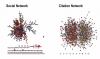
    Visualization of the sharing ideas and practices across borders, roles, and system levels in the COVID-19 Peer Hub

    Co-design as a networked practice of continuous invention, innovation, and learning

    For COVID-19 vaccine introduction to succeed, we need new ways to disseminate rapid learning. Through co-design with members of our platform, we invented two in the first three months of this year: Teach to Reach: Connect and the COVID-19 Peer Hub Inter-Country Learning Collaborative to support vaccine introduction.

    We already knew that presentation webinars do little more than replicate classroom training in a digital format. Yet they proliferate, despite the dearth of evidence about their effectiveness, with unsubstantiated claims that they are somehow “collaborative” or that 10 minutes of attendees asking the experts a few questions qualifies as “peer learning”. Social Network Analysis (SNA) of the COVID-19 Peer Hub by Sasha Poquet and Vitomir Kovanovic at the Centre for Complexity and Change in Learning helped us to understand that the power of the network lies in the relationships between its members, not only in our ability to convene or call to action, and certainly not in one-way information transmission.

    So, on Friday 26 March 2021, 1,372 immunization professionals attended Teach to Reach: Connect to meet, network, and learn about COVID-19 vaccine introduction, how to improve immunization training, and how to reach “zero-dose” children. The feedback received from participants has been incredible, starting with their own surprise that they had so much to learn from each other. (You can catch the opening ceremony on our YouTube channel, and we will soon be sharing what we learned in upcoming live-streamed events on our Facebook page.)

    My first networking meeting during Teach to Reach: Connect. Wasnam Faye is a district midwife in Senegal. I remembered her sharing powerful testimonial about how she took practical steps to ensure safe vaccination and explained the words she used to reassure caregivers, when the pandemic first hit.

    An inter-country peer learning collaborative to accelerate COVID-19 vaccine introduction

    The next day, the COVID-19 Peer Hub team from the Democratic Republic of the Congo (DRC) invited their colleagues from Ivory Coast to learn from the latter’s experience of vaccine introduction. Participants compared the enthusiasm to that for a football match, only this time, they said, the purpose was to “kick out the Coronavirus”. The meeting, hosted by DRC Peer Hub team leader Franck Monga and facilitated by a brilliant young doctor from Burkina Faso, Palenfo Dramane, drew over 1,000 attendees from 20 francophone countries. Panelists from Ivory Coast were alumni of Foundation programmes directly involved in vaccine introduction, working at various levels of the system. They shared first-hand experience from the first few weeks of vaccine introduction. Attendance barely declined even though the meeting ran over time by more than 90 minutes.

    Our ‘grand challenge’

    Our biggest challenge, so far, has been to explain the power, significance, potential, and value of such events to our global partners. This is ironic given that the global immunization community agrees that it is sub-national immunization staff who make the difference needed to achieve Immunization Agenda 2030, the new strategy adopted last year by the World Health Assembly. Some global colleagues did take the time to apologize, explaining that they were too busy on Friday afternoon due to COVID-19 vaccine introduction to take 15 minutes to meet, network, and learn with immunization staff from the countries they serve and who are actually introducing the vaccine. (To be fair, a few colleagues did attend and loved it.) Last but not least, donors remain risk-adverse, preaching innovation while repeatedly choosing conventional approaches and traditional partners, even when they have failed in the past, seemingly driven by considerations other than scale, results, or demand from countries. In some cases, they have even expressed disbelief, doubting our results as too good to be true, flummoxed by how a new entrant with limited immunization experience could achieve them when better-funded, far-more-legitimate institutions have simply not been able to do so.

  • Solidarity across public health and medicine silos during a pandemic

    Solidarity across public health and medicine silos during a pandemic

    We are launching a new Scholar programme about environmental threats to health, with an initial focus on radiation. (I mapped out what this might look like in 2017.) As part of the launch, we are enlisting support of immunization colleagues.

    Our immunization programme is our largest and most advanced programme, and still growing fast since its inception in 2016. At The Geneva Learning Foundation, we have spent 5 years pouring mind, body, and soul into building what has become the largest digital platform for national and sub-national immunization leaders.

    Along the way, we discovered that it is not only about scale. Social Network Analysis (SNA) by colleagues Sasha Poquet and Vitomir Kovanovic at the Centre for Complexity and Change in Learning is now helping us to understand the power in the relationships not just one-to-many but many-to-many across the network.

    Yes, there is a linkage as most vaccines are for children, and our first course in the new programme (with WHO) is about communicating radiation risks in paediatric imaging. But I was not sure if our request for help would make sense to the immunization network, especially when so many immunization staff are overwhelmed by COVID-19 vaccine introduction.

    Yet, in less than 2 hours, immunization colleagues had already shared the announcement over 300 times. This is an impressive display of solidarity across public health and medicine silos.

    This bodes well for the Foundation’s work as we are developing new programmes in other areas of global health, such as non-communicable diseases (NCDs) or neglected tropical diseases (NTDs) like female genital schistomiosis (FGS).

    Until this morning, I was not sure to what extent one programme’s members would be willing to support others, outside their field of specialty.